
Insights · 5 min read
Where to shut off? The right point for your main valve
In a water emergency, every second counts — and when installing an automatic leak-protection system, choosing the correct shut-off point is just as critical. The ideal is as close to the inlet as possible. But if you touch the wrong valve, you risk trouble with your water utility. This article explains which valve is yours, which isn't, and when an alternative shut-off point is the smarter choice.
From the street to your home — who owns what?
The water line running to your home splits into three sections:
- Service line (street to house entry) — installed and maintained by the water utility. Ends with the main shut-off valve before the meter.
- Main water meter — property of the utility. It must not be replaced, moved, or even had its seal broken. There is typically a shut-off valve immediately before and after the meter; the one before the meter also belongs to the utility's zone of responsibility.
- Home installation (after the water meter) — property of the homeowner. From here on everything is your responsibility: pipes, risers, floor and appliance connections.
Rule of thumb: the main water meter is the boundary. Everything before it belongs to the utility, everything after it belongs to you.
The right valve for the automatic shut-off motor
The consequence: for automatic leak protection, only the shut-off valve directly downstream of the water meter — the customer-side valve — is a candidate. It is your property, and you may operate it, replace it or add an attachment without asking the utility. The Aqua-Scope motor mounts directly onto the existing ball valve (Water Guard Ball Valve motor) or angle-seat head (Water Guard KFR motor) — no pipe cutting, no coordination with the utility, and the whole thing is removable at any time.
This valve sits as close to the water inlet as technically possible — which means it protects the entire home installation. That is the point: whatever drips, bursts or overflows inside the house, closing this one valve stops it.
When the main area is in poor shape
In many older buildings, the situation around the water meter is far from ideal: seized or scaled-up shut-off valves, corroded fittings, wall proximity that leaves no room for a motor.
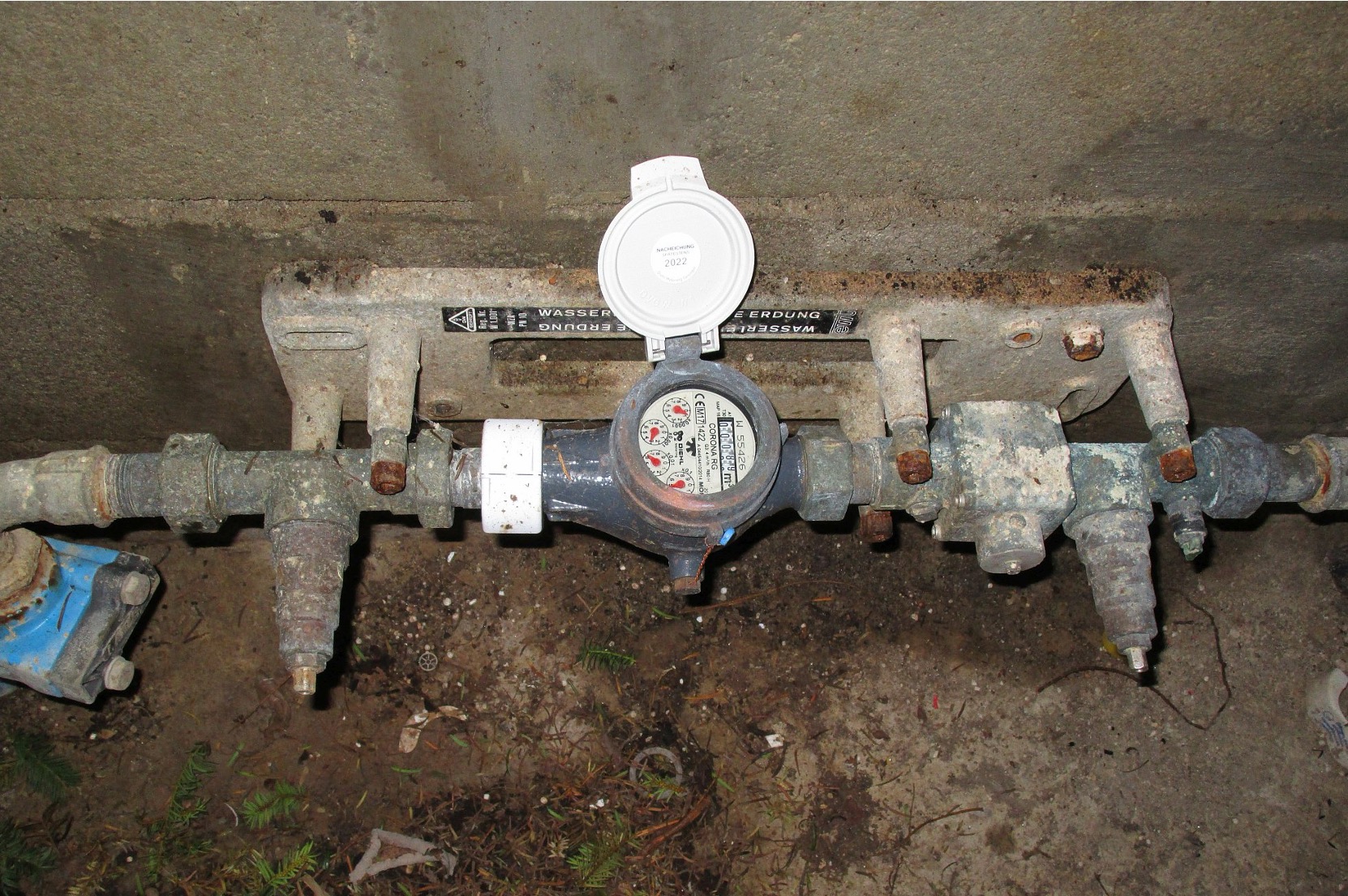
A common sight in existing buildings: meter and customer-side valve visibly aged. Operating the valve here may cause a leak — and put you in a conversation with the water utility.
In such cases, an alternative shut-off valve further downstream can be the more pragmatic choice: for example the manifold in the utility riser, a floor-level shut-off, or the entry valve to your apartment. The protected zone is smaller (anything between the meter and the new shut-off remains unprotected), but:
- You avoid touching brittle components in the main zone.
- You side-step potential responsibility disputes with the utility.
- Installation is often simpler, and the motor is more accessible for later maintenance.
Ideally, pick a valve upstream of the first branch to any appliance — that way no unprotected water flows into the protected zone.
Renting? The apartment shut-off is your friend
As a tenant or apartment owner, you typically have no right to access the central shut-off in the basement — but you do have access to the valve at the apartment entry (usually hidden behind a service hatch in the bathroom or kitchen area). The Aqua-Scope motor works here too, and covers every consumption point inside the apartment. If in doubt, run it past the landlord — the installation leaves no trace and doesn't count as a structural alteration.
Practical rules of thumb
- Turn it once before you buy. Check whether the chosen valve actually moves. If it's stuck, a plumber is the better first step.
- Hands off the meter. The seal on the water meter is off-limits — breaking it triggers replacement fees and back-charges.
- Ball valve or angle seat? Both work with the Aqua-Scope motor. Ball valves are today's standard and close with a quick 90° turn.
- Accessible beats optimal. A valve you can't see and can't reach is a valve that won't get serviced. When in doubt, choose the more accessible point.
- Multiple valves? No problem. Several Aqua-Scope motors at different shut-off points can be coordinated — useful across multiple apartments or floors.
Your shut-off point, protected in under 10 minutes
Once you've picked the right valve, installing the Aqua-Scope motor is a matter of minutes — no pipe cutting, no plumber, no water shut-off from the utility. In the event of a leak, one of our sensors triggers the motor and closes the valve automatically. You get a push notification on your phone.