
Insights · 7 min read
The most frequent causes of piped-water damage
Where does the drinking-water system most often go wrong? The German Institute for Damage Prevention and Damage Research of Public Insurers (IFS) has been analysing reported damage cases by their cause for years. The numbers deliver a clear message: around 40 % of all piped-water damage is not caused by defective materials, but by faulty installation and assembly. Here's an overview of the component categories with the most frequent damage — and how many of them can be prevented.
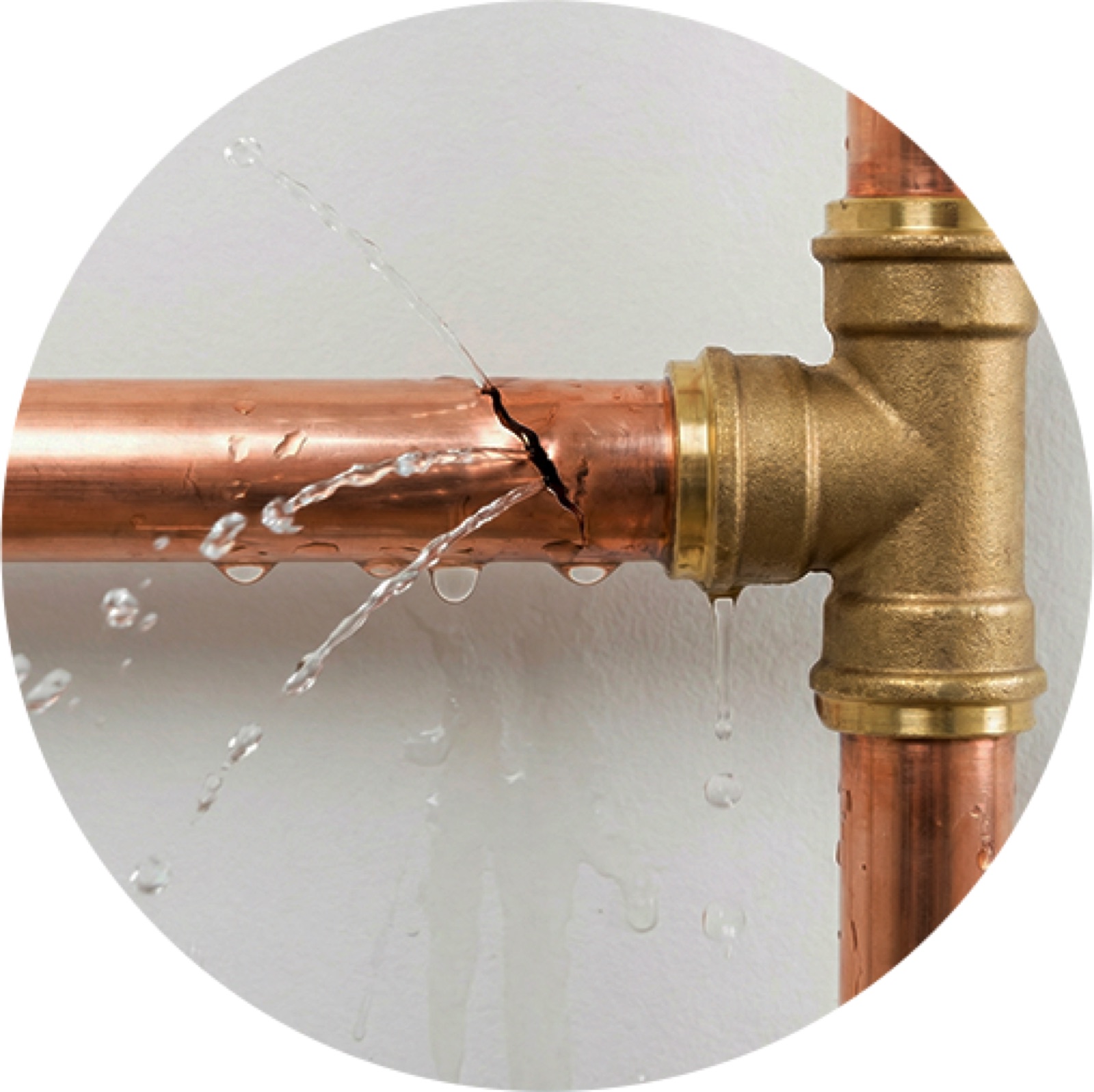
Distribution of damage-causing component categories
The IFS statistics group damage cases by the affected component. Two categories share the top spot and together account for more than half of all incidents:
| Rank | Component category | Share | Typical problems |
|---|---|---|---|
| 1 | Components, appliances and installations | 26 % | Installation errors, lack of maintenance, incorrect operation |
| 1 | Connections | 26 % | Assembly errors, badly executed press-fittings |
| 3 | Pipes | 20 % | Corrosion, ageing, material wear |
| 4 | Fittings and valves | 17 % | Assembly errors, material failure |
| 5 | Hoses | 11 % | Corrosion, ageing, material fatigue |
Most frequent damage by component
Within the categories, a short list of specific components stands out. They account for a large share of reported cases — in both new and existing installations.
| Component | Share | Most frequent cause |
|---|---|---|
| Press and clamp connections | 11.2 % | Pipe not inserted deep enough, defective press-fitting |
| Flexible connection hoses | 9.4 % | Corrosion of the stainless-steel braid, ageing |
| Copper pipes | 8.2 % | Pitting corrosion, material / water incompatibility |
| Boilers and hot-water tanks | 5.7 % | Incorrect connection, operation or installation errors |
| Angle valves | 4.0 % | Faulty assembly, stress-corrosion cracking |
| Mixer taps | 4.0 % | Material and assembly errors |
| Galvanised steel pipes | 3.0 % | External corrosion due to moisture |
Typical causes and prevention
Almost every problem spot has a typical cause — and a similarly clear preventive action. If you own (or rent out) a drinking-water installation, this list captures the main levers:
| Problem spot | Typical cause | Preventive action |
|---|---|---|
| Press-fittings | Pipe not inserted deep enough or badly pressed | Follow the manufacturer's specification and perform a tightness test |
| Boilers / small tanks | Wrong fitting installed | Use only matching fittings |
| Copper pipes | Corrosion and ageing | Choose a suitable material / water combination |
| Steel pipes | Moisture in the floor structure causes external corrosion | Seal pipe pass-throughs professionally |
| Angle valves | Wrong sealing, insufficient thread engagement | Install according to manufacturer specifications |
| Flexible connection hoses | Corrosion by chloride cleaners, ageing | Inspect regularly and replace after about 20 years at the latest |
Key findings
| Rank | Problem | Meaning |
|---|---|---|
| 1 | Installation and assembly errors | About 40 % of all incidents are caused by faulty workmanship. |
| 2 | Press and clamp connections | The single most common damage source within all connections. |
| 3 | Flexible connection hoses | High incident frequency due to corrosion and ageing. |
| 4 | Boilers and small tanks | Often incorrectly installed or operated. |
| 5 | Copper and steel pipes | Corrosion and material ageing are the main causes. |
| 6 | Angle valves | Faulty assembly regularly leads to water damage. |
Bottom line
The analysis clearly shows that most piped-water damage is not caused by defective materials, but by installation and assembly errors. The most critical points are press-fittings, flexible connection hoses, boilers, copper and steel pipes, and angle valves. Proper installation, regular maintenance and timely replacement of ageing components prevent a large share of damage — the remainder is contained by early detection and automatic shut-off.
Where Aqua-Scope changes the picture
Even with careful installation, no water damage can be ruled out 100 % — hoses age, connections loosen, materials fatigue. That is exactly where Aqua-Scope steps in:
- The Monitor / Monitor Plus detects microleakages from 100 ml/h — exactly the initial signature of ageing connections and supply hoses.
- The Flood Sensor responds on the floor to water escaping from a washing machine, sink, boiler or safety valve.
- The Water Guard (KFR) or Water Guard (Ball Valve) automatically closes the main valve — before the small leak turns into a claim.
Source
The figures in this article are drawn from the damage-cause statistics of the German Institute for Damage Prevention and Damage Research of Public Insurers (IFS). Current analyses can be found at www.ifsev.org.